About the artwork
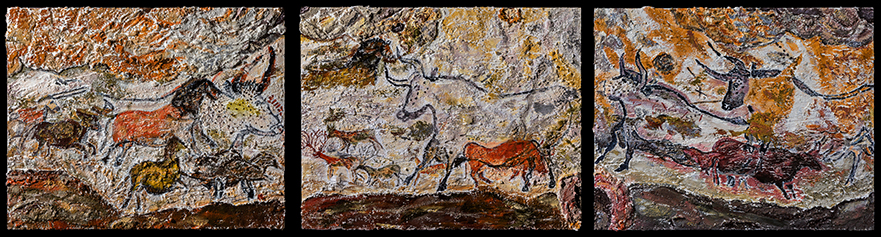
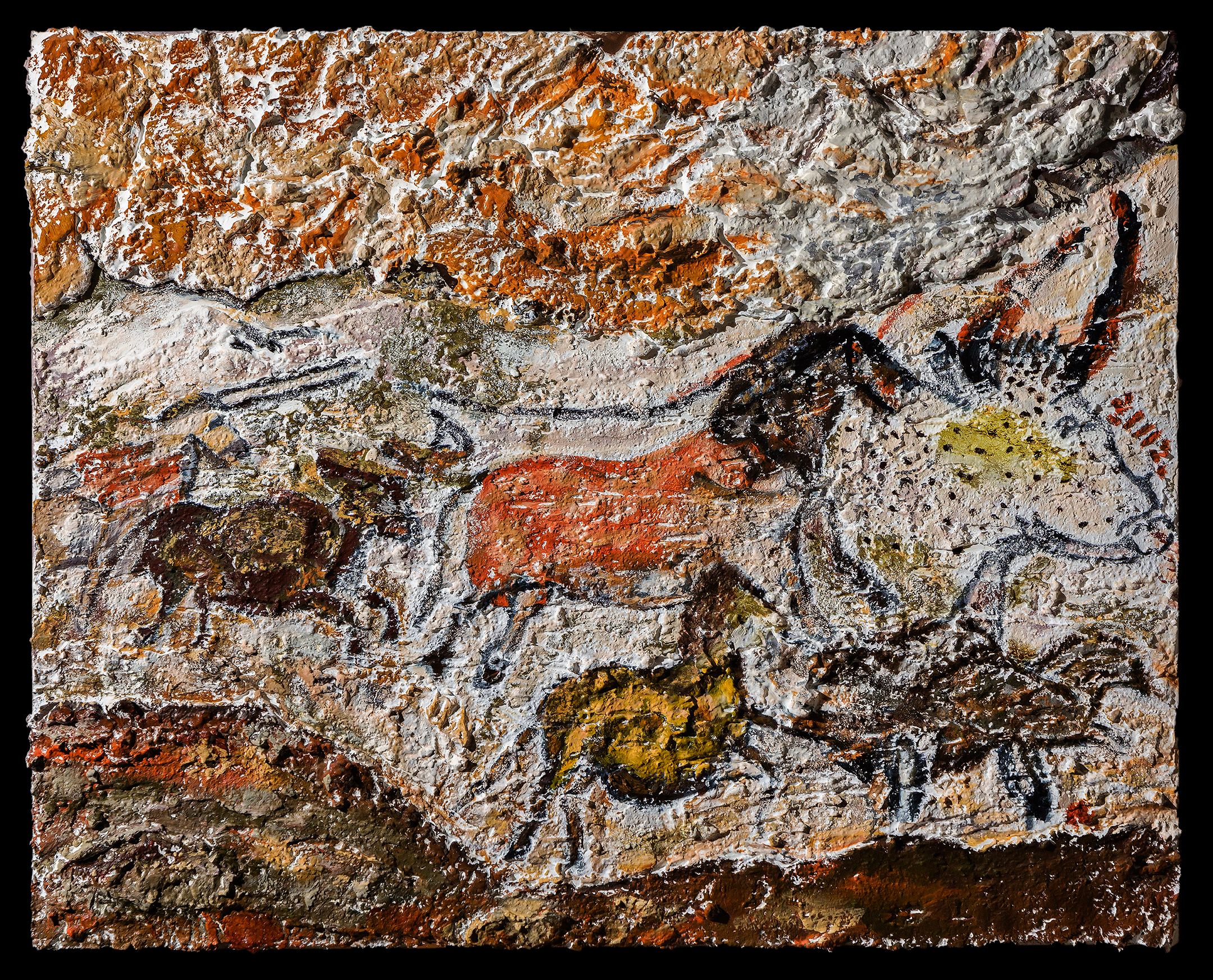
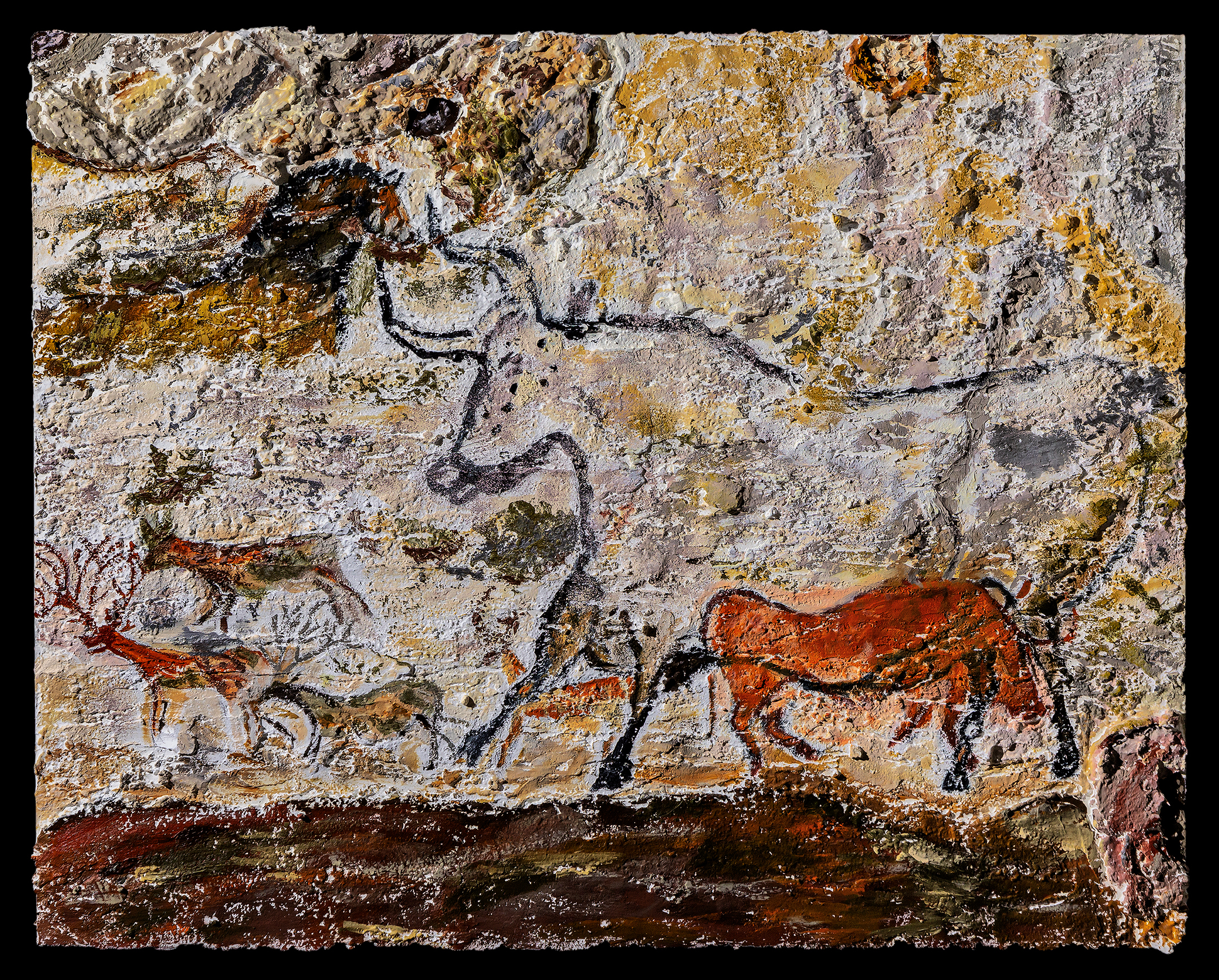
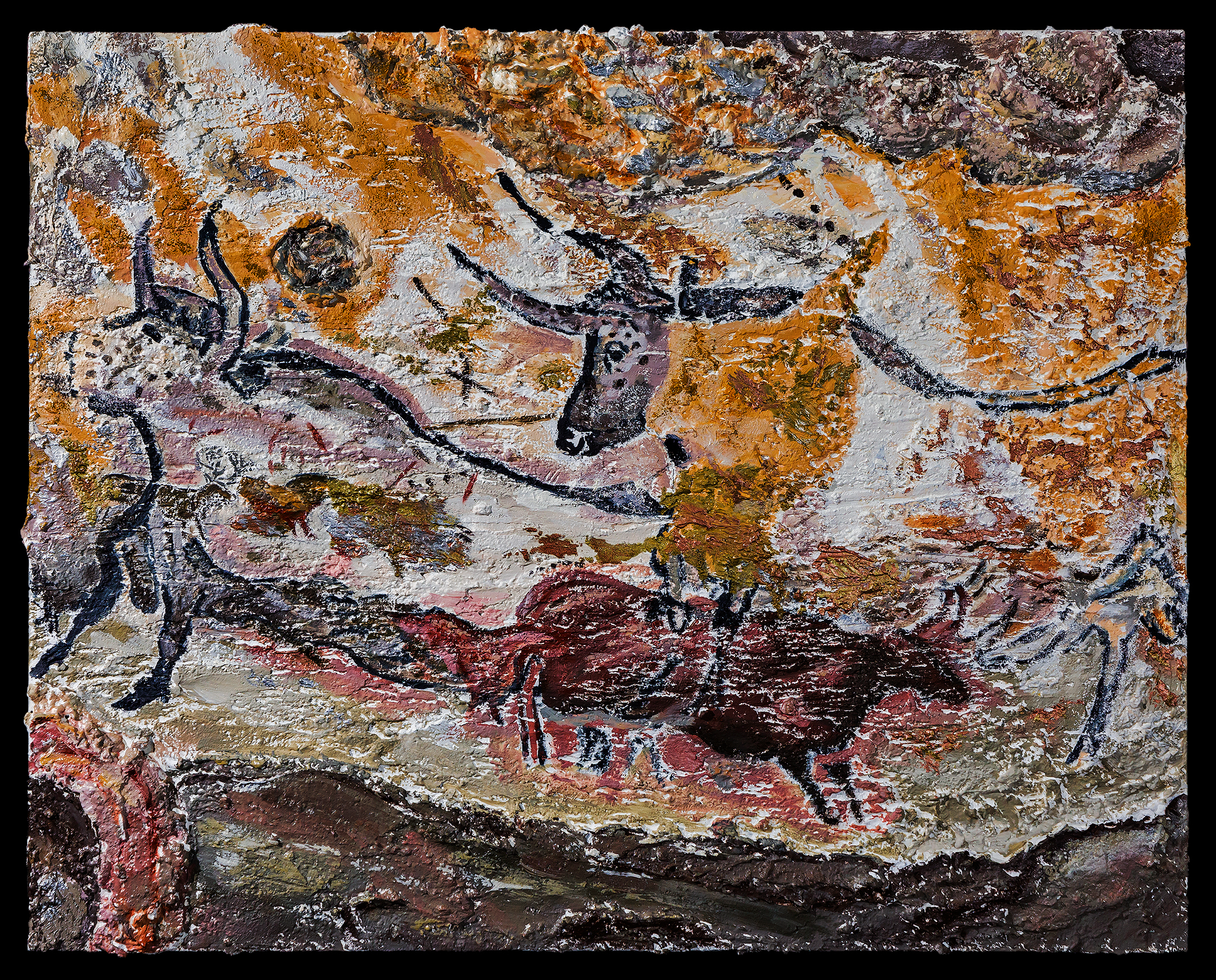
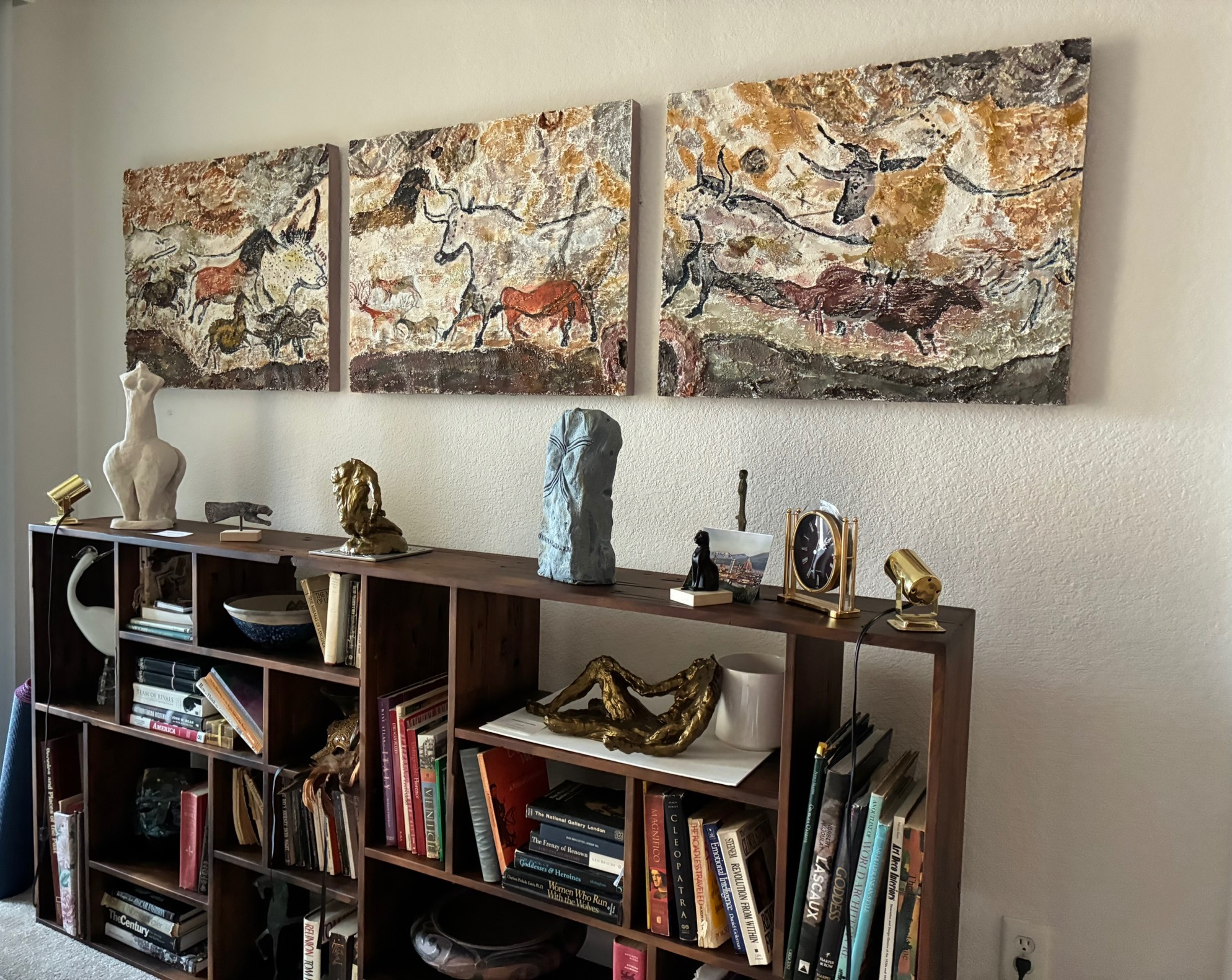
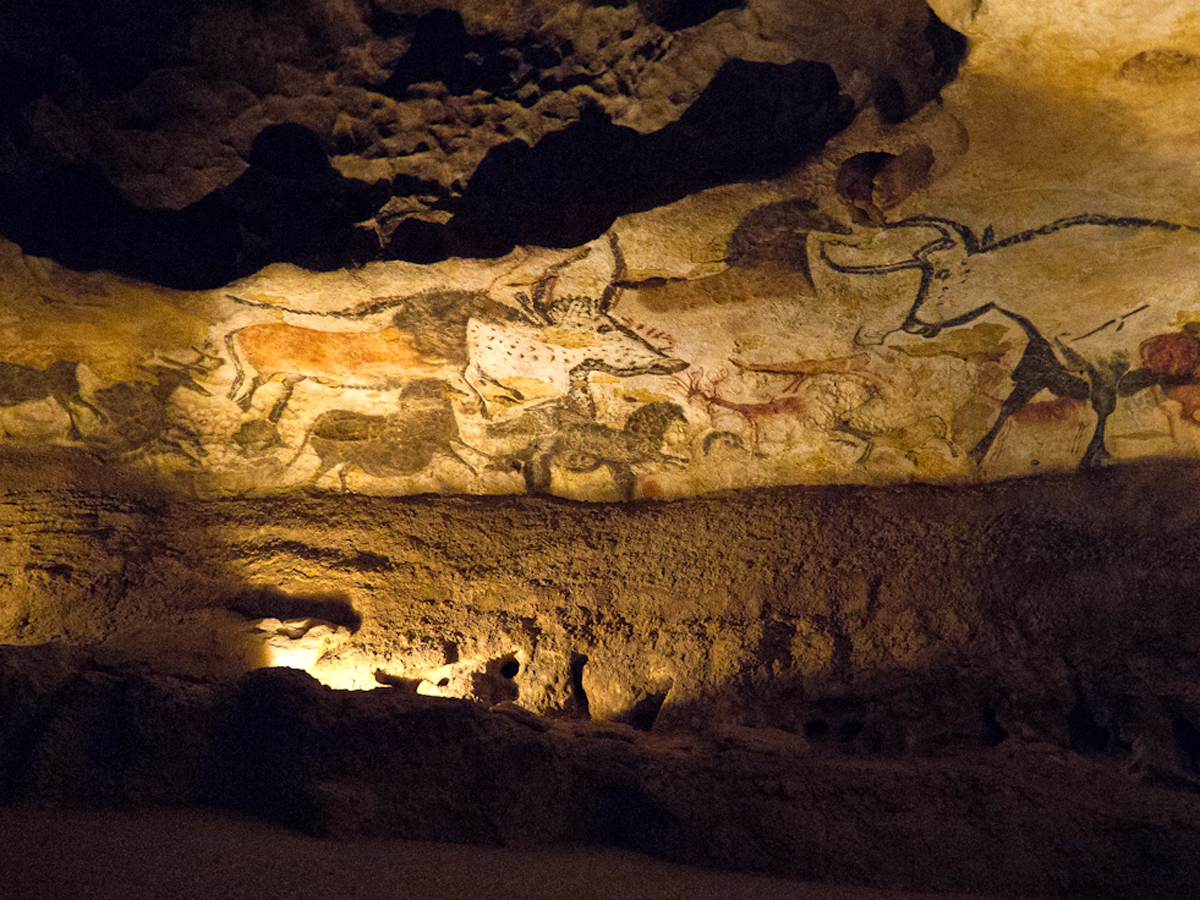
Sharing the Land is part of my six-work Cave Art series that aims to resurrect the primal power and beauty of scenes from caves of the Upper Paleolithic Era, or Late Old Stone Age: Chauvet-Pont-d’Arc (30,000 B.C.) in France, Lascaux ((15,500 B.C.) in France, and Altamira (14,500 B.C.) in Spain. Cro-Magnon shaman artists fashioned reverential masterworks of the lives, movements, and spiritual energy of the animals of their worlds. Sharing the Land narrates animals moving in opposite directions and images of various size and colors, some as superimpositions, some in the distance, for short and long perspective, inspired by paintings in the Lascaux Cave (see last image in Gallery). The original frieze was painted on a smoother cave wall sandwiched between ochre- and stone-colored rocky eaves and a dark craggy ledge, both created here by excess build up of stucco, a base material used in all of my cave art recreations to mimic the uneven surface and cauliflower texture of the original limestone caves. Also used through out the piece were paints of metallic copper, silver, and gold to affect patches of minerals embedded in the real rock. More specifically, in Panel One, stampeding horses over power a big bull image, set apart with dotting, while the personality of the horses are distinguished by their varied gates (leaps, gallops, etc.) and colors (red, tortoiseshell, gold). In Panel Two, stand-out images are delicate deer figures, a glazed red cow superimposed over a big bull's belly, and a natural rock crack shooting down from the right onto the cow's hind playing like a bolt of lightning. In Panel Three, the large proportions of a cow and bull make them omnipresent and dominant over a tiny stag and horse overlay. The line work and patchwork of colors makes for a beautiful abstract treatment. Sharing the Land is a true statement piece, be it in contrast to minimalist environs or within a rustic Western setting. During my re-creation process while in my own “cave” during the COVID lockdowns, I discovered that the works seemed very contemporary in aesthetic. The shamans used – perhaps even invented – abstract visual language; they coalesced composition, color, texture, line, shape, form, patterns, and symbols. While the images are technically old, they also seem current because contemporary art has embraced abstract art techniques. As does my Cave Art series by extension, making them perfect fits under the umbrella motif of my works here, Ancient is Modern, Modern is Ancient, which also includes my Goddess Eternal and Southwest Landscape series.Medium Details
Stucco, Acrylic, & Oil on Panel
Frame
Unframed to allow stucco base to spill over the sides for authentic effect
Signature
Intend to display as triptych, but each panel (30" X 24") could function as stand-alone painting -- so four paintings in one!!!
Condition
15,500 B.C. Redux: Sharing the Land, Lascaux Cave, France

Like this piece of artwork
To express appreciation for a piece of artwork kindly share your email address to enable one like per viewer. This feature allows for showcasing popular preferences among viewers. We will also send you updates on this piece.

Mixed media
Abstract
24 H x 95 W x 1.5 D in
A sweeping panorama of peaceful co-existence between animals living on the land in the Paleolithic era.
Seller: Jacqueline Savaiano Art
PRICE
$8,500

SHIPPING
Shipping arrangements are handled between buyers and sellers.

SECURE PAYMENT
Secure transactions by credit card, or ACH payment.
Have a question? Visit our help center.
About the artwork
Sharing the Land is part of my six-work Cave Art series that aims to resurrect the primal power and beauty of scenes from caves of the Upper Paleolithic Era, or Late Old Stone Age: Chauvet-Pont-d’Arc (30,000 B.C.) in France, Lascaux ((15,500 B.C.) in France, and Altamira (14,500 B.C.) in Spain. Cro-Magnon shaman artists fashioned reverential masterworks of the lives, movements, and spiritual energy of the animals of their worlds. Sharing the Land narrates animals moving in opposite directions and images of various size and colors, some as superimpositions, some in the distance, for short and long perspective, inspired by paintings in the Lascaux Cave (see last image in Gallery). The original frieze was painted on a smoother cave wall sandwiched between ochre- and stone-colored rocky eaves and a dark craggy ledge, both created here by excess build up of stucco, a base material used in all of my cave art recreations to mimic the uneven surface and cauliflower texture of the original limestone caves. Also used through out the piece were paints of metallic copper, silver, and gold to affect patches of minerals embedded in the real rock. More specifically, in Panel One, stampeding horses over power a big bull image, set apart with dotting, while the personality of the horses are distinguished by their varied gates (leaps, gallops, etc.) and colors (red, tortoiseshell, gold). In Panel Two, stand-out images are delicate deer figures, a glazed red cow superimposed over a big bull's belly, and a natural rock crack shooting down from the right onto the cow's hind playing like a bolt of lightning. In Panel Three, the large proportions of a cow and bull make them omnipresent and dominant over a tiny stag and horse overlay. The line work and patchwork of colors makes for a beautiful abstract treatment. Sharing the Land is a true statement piece, be it in contrast to minimalist environs or within a rustic Western setting. During my re-creation process while in my own “cave” during the COVID lockdowns, I discovered that the works seemed very contemporary in aesthetic. The shamans used – perhaps even invented – abstract visual language; they coalesced composition, color, texture, line, shape, form, patterns, and symbols. While the images are technically old, they also seem current because contemporary art has embraced abstract art techniques. As does my Cave Art series by extension, making them perfect fits under the umbrella motif of my works here, Ancient is Modern, Modern is Ancient, which also includes my Goddess Eternal and Southwest Landscape series.Medium Details
Stucco, Acrylic, & Oil on Panel
Frame
Unframed to allow stucco base to spill over the sides for authentic effect
Signature
Intend to display as triptych, but each panel (30" X 24") could function as stand-alone painting -- so four paintings in one!!!
Condition
About the artist
Jacqueline Savaiano - United States
Jacqueline Savaiano is a San Diego-based artist who creates oil and acrylic paintings, sculptures, ceramics, and mixed media works since 2008. Ancient is Modern, Modern...
See Artist's Page