About the artwork
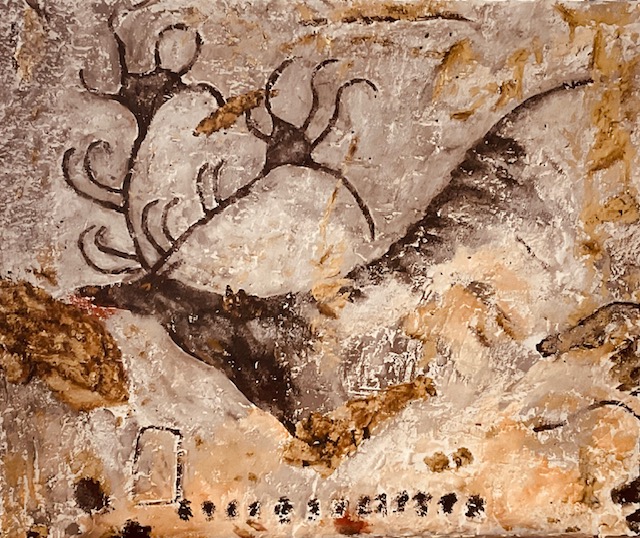
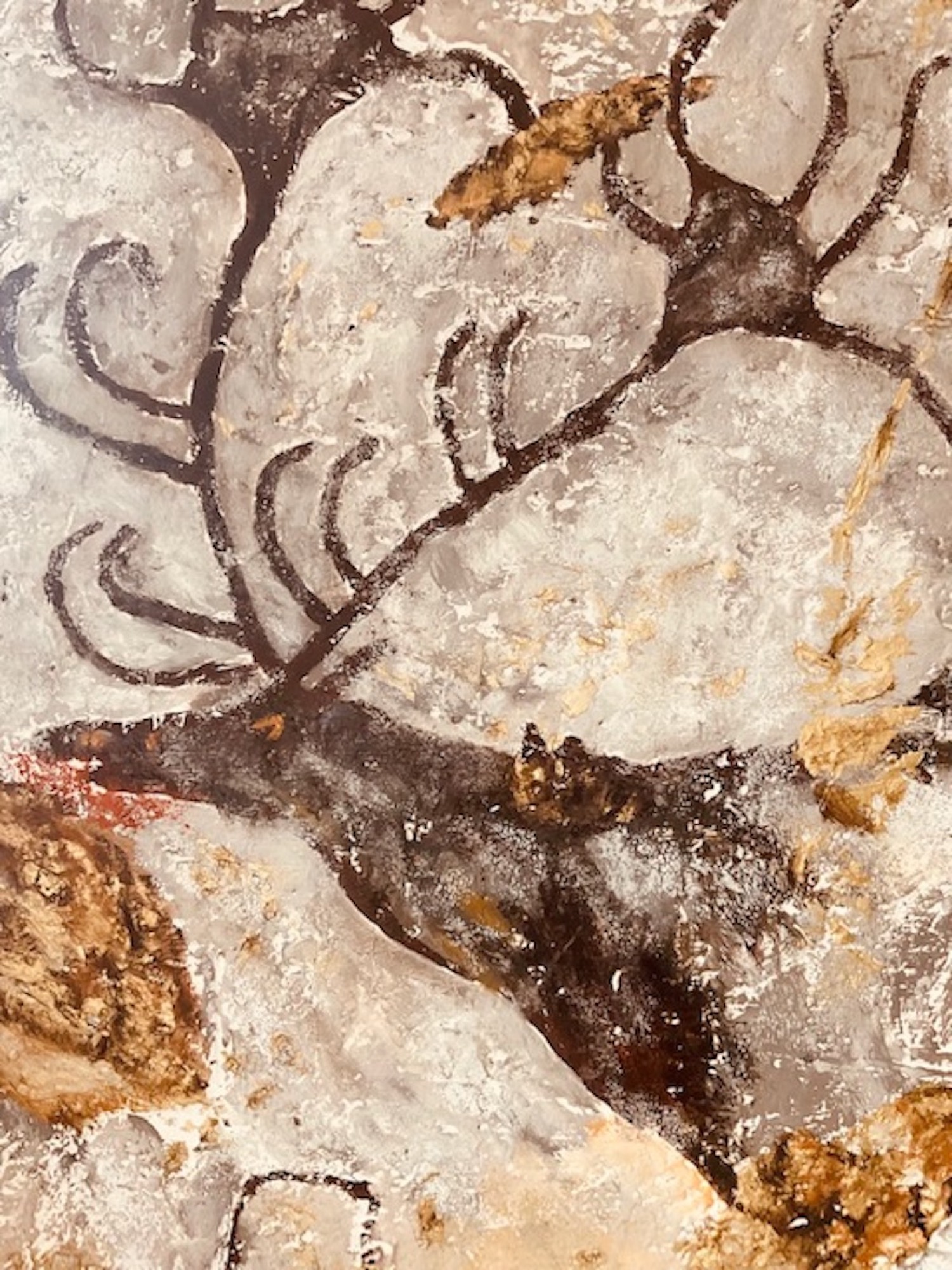
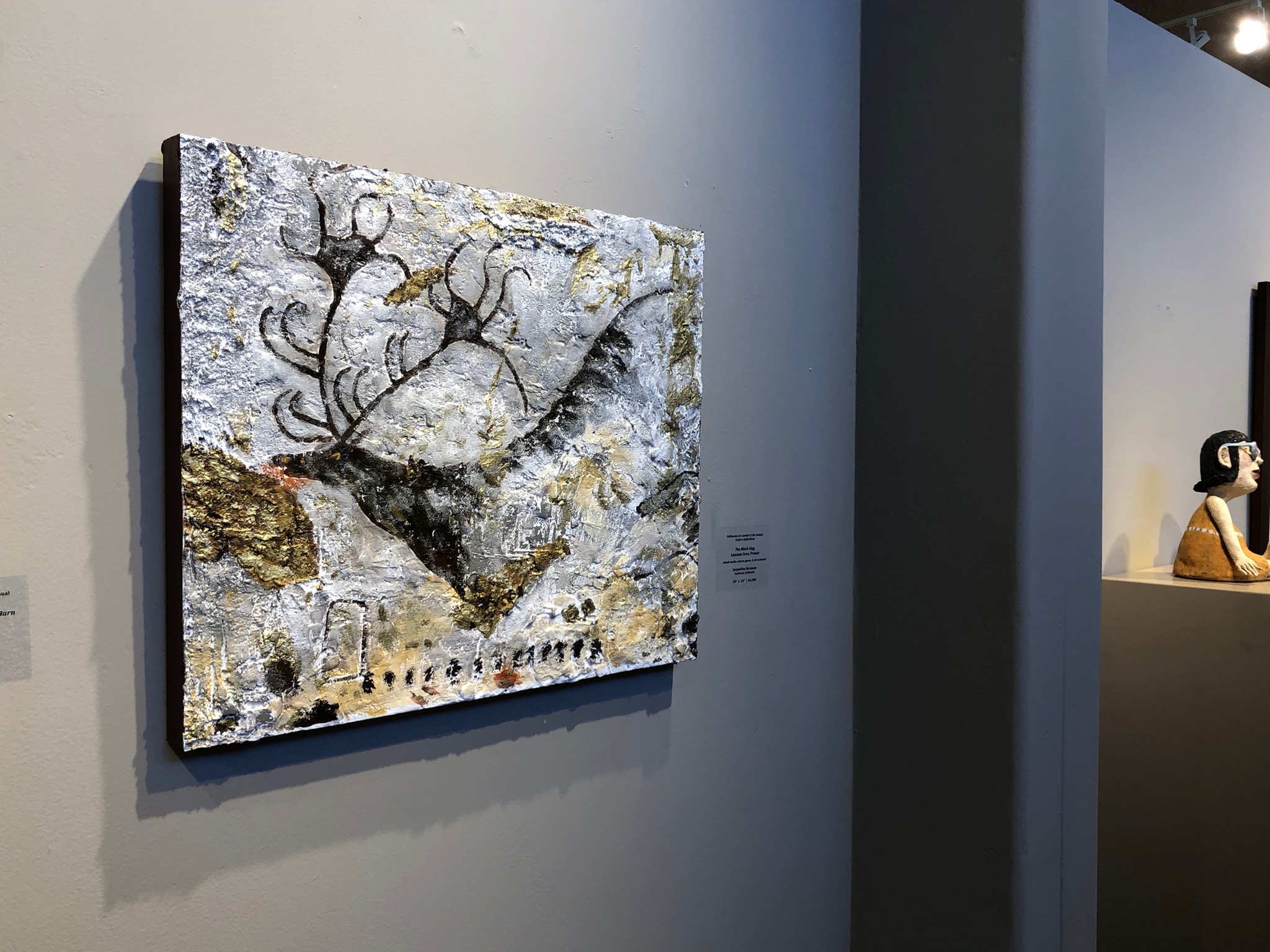
The Black Stag is part of my six-work Cave Art series that aims to resurrect the primal power and beauty of scenes from caves of the Upper Paleolithic Era, or Late Old Stone Age: Chauvet-Pont-d’Arc (30,000 B.C.) in France, Lascaux ((15,500 B.C.) in France, and Altamira (14,500 B.C.) in Spain. Cro-Magnon shaman artists fashioned reverential masterworks of the lives, movements, and spiritual energy of the animals of their worlds. The Black Stag re-creates an enigmatic, powerful image from the Lascaux Cave of a truly magnificent stag of the Paleolithic era. A 1,500-pound stag flaunts the largest antlers ever known -- 12 feet in diameter and 90 pounds. In the shaman's stylized rendering, colossal crowns with strange tines arch backward to heighten the body's curves and create forward movement. A distorted eye, looking back, and reddish exhales suggest fear and fury as he charges away. Although the shaman drew the stag with black charcoaled wood, I chose an understated chocolate set against a dignified palette of stone, creams, and yellows. Gold leaf affects a precious metal embedded in the original rock, a final touch for this regal animal, now extinct in reality but living forever in art. In all of my mixed media interpretations of the parietal images, a stucco base mimics the uneven surface and cauliflower texture of the original limestone caves. The pieces can play as a contrast and/or statement piece in minimalist environs or blend in well in rustic Western settings. During my re-creation process while in my own “cave” during the COVID lockdowns, I discovered that the works seemed very contemporary in aesthetic. The shamans used – perhaps even invented – abstract visual language; they coalesced composition, color, texture, line, shape, form, patterns, and symbols. While the images are technically old, they also seem current because contemporary art has embraced abstract art techniques. As does my Cave Art series by extension, making them perfect fits under the umbrella motif of my works here, Ancient is Modern, Modern is Ancient, which also includes my Goddess Eternal and Southwest Landscape series.Medium Details
Stucco, Acrylic, & Oil on Panel
Frame
Unframed to allow stucco base to spill over the sides for authentic effect
Signature
Graceful line connecting back and antler to create forward motion and gold leafing to mimic metal embedded in stone surface
Condition
17,000 B.C. Redux: The Black Stag, Lascaux Cave, France

Like this piece of artwork
To express appreciation for a piece of artwork kindly share your email address to enable one like per viewer. This feature allows for showcasing popular preferences among viewers. We will also send you updates on this piece.

Mixed media
Abstract
20 H x 24 W x 1.5 D in
Magnificence in reality and parietal art during the Paleolithic era
Seller: Jacqueline Savaiano Art
PRICE
$3,200

SHIPPING
Shipping arrangements are handled between buyers and sellers.

SECURE PAYMENT
Secure transactions by credit card, or ACH payment.
Have a question? Visit our help center.
About the artwork
The Black Stag is part of my six-work Cave Art series that aims to resurrect the primal power and beauty of scenes from caves of the Upper Paleolithic Era, or Late Old Stone Age: Chauvet-Pont-d’Arc (30,000 B.C.) in France, Lascaux ((15,500 B.C.) in France, and Altamira (14,500 B.C.) in Spain. Cro-Magnon shaman artists fashioned reverential masterworks of the lives, movements, and spiritual energy of the animals of their worlds. The Black Stag re-creates an enigmatic, powerful image from the Lascaux Cave of a truly magnificent stag of the Paleolithic era. A 1,500-pound stag flaunts the largest antlers ever known -- 12 feet in diameter and 90 pounds. In the shaman's stylized rendering, colossal crowns with strange tines arch backward to heighten the body's curves and create forward movement. A distorted eye, looking back, and reddish exhales suggest fear and fury as he charges away. Although the shaman drew the stag with black charcoaled wood, I chose an understated chocolate set against a dignified palette of stone, creams, and yellows. Gold leaf affects a precious metal embedded in the original rock, a final touch for this regal animal, now extinct in reality but living forever in art. In all of my mixed media interpretations of the parietal images, a stucco base mimics the uneven surface and cauliflower texture of the original limestone caves. The pieces can play as a contrast and/or statement piece in minimalist environs or blend in well in rustic Western settings. During my re-creation process while in my own “cave” during the COVID lockdowns, I discovered that the works seemed very contemporary in aesthetic. The shamans used – perhaps even invented – abstract visual language; they coalesced composition, color, texture, line, shape, form, patterns, and symbols. While the images are technically old, they also seem current because contemporary art has embraced abstract art techniques. As does my Cave Art series by extension, making them perfect fits under the umbrella motif of my works here, Ancient is Modern, Modern is Ancient, which also includes my Goddess Eternal and Southwest Landscape series.Medium Details
Stucco, Acrylic, & Oil on Panel
Frame
Unframed to allow stucco base to spill over the sides for authentic effect
Signature
Graceful line connecting back and antler to create forward motion and gold leafing to mimic metal embedded in stone surface
Condition
About the artist

Jacqueline Savaiano - United States
Jacqueline Savaiano is a San Diego-based artist who creates oil and acrylic paintings, sculptures, ceramics, and mixed media works since 2008. Ancient is Modern, Modern...
See Artist's Page